
 TrendPedia
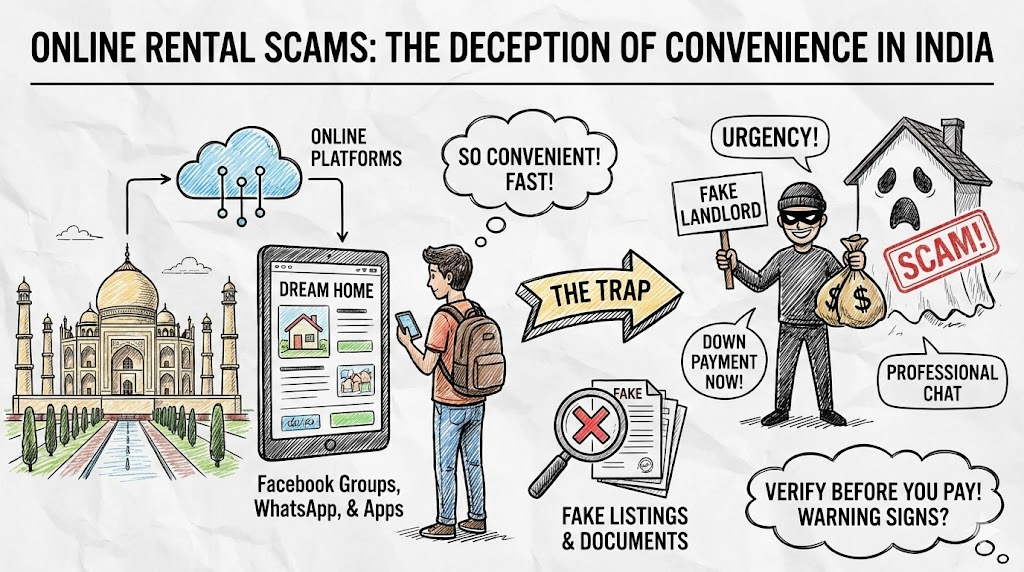
 In India, it has become customary to locate a rental property online. The promise of speed and convenience in property applications, Facebook groups, WhatsApp listings, and broker messages is particularly beneficial in the bustling cities, where high-quality homes are sold in mere minutes.
Fraudsters currently post attractive advertisements on properties that are either undesired, occupied, or never existed for the purpose of renting. Their urgency and demands are employed to secure a down payment and flee the scene, frequently before the victim is aware that something has gone awry. The most detrimental aspect of these schemes is their facade of ordinariness. The listings are realistic, the discussions are professional, and the amounts requested are reasonable enough to be sent without hesitation.
This paper unravels the mechanics of fake rental scams, the reason why such a large number of individuals fall victim to them, and the warning signs that can help you avoid losing money before you even set foot in a property. Currently, the manner in which the search for a home is being manipulated, as well as the measures that can be taken to prevent it, necessitates a more thorough examination.
What Are Fake Rental & Housing Scams?
Fake rental and housing scams occur when fraudsters post false or misleading property listings in order to extort money from individuals who are interested in renting the properties.
They typically pose as property owners, brokers, or even community administrators in order to appear authentic. Renters are led to believe that a property is in high demand and is available by employing persuasive language and visually appealing images.
The fraudster ceases to communicate with you upon receipt of an advance payment, booking amount, or “token.” The property is either a phony, is not available for rent, or was never associated with the individual who is advertising it.
Why Rental Scams Are Increasing Rapidly
The surge in rental fraud is driven by structural changes in how people search for housing, combined with market pressure.
1) Online House Hunting Is Now the Default
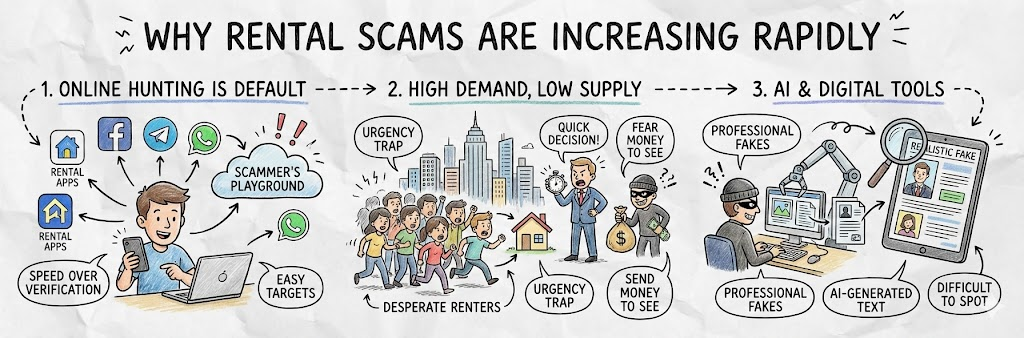
Most renters now start looking for a place to live on rental apps, Facebook groups, Telegram channels, and WhatsApp listings. These sites put speed and volume ahead of verification, which makes them great places for scammers to work. People who commit fraud go where there is already a need, and desperate renters are easy to find online.
2) High Demand and Low Supply in Urban Cities
Rental demand is always higher than supply in cities like Bengaluru, Mumbai, Delhi, and Hyderabad. Good properties go fast, brokers push for quick decisions, and tenants feel like they have to act before “someone else takes it.” Scammers take advantage of this fear. Renters send money just to get a chance to see a property instead of having to verify it.
3) AI and digital tools make fake listings look real.
Fraud in modern times does not appear messy. Fraudsters are currently spending stolen property photos, text created by AI and appearing professional, as well as forging documents like rental documents or identification documents. Consequently, counterfeit listings can appear to be genuine listings at face value. Urgency, realism, and the digital convenience have combined to make rental scams more believable, urgent, and difficult to spot as they have never been before.
Common Types of Rental & Housing Scams
1) Fake Owner Listings
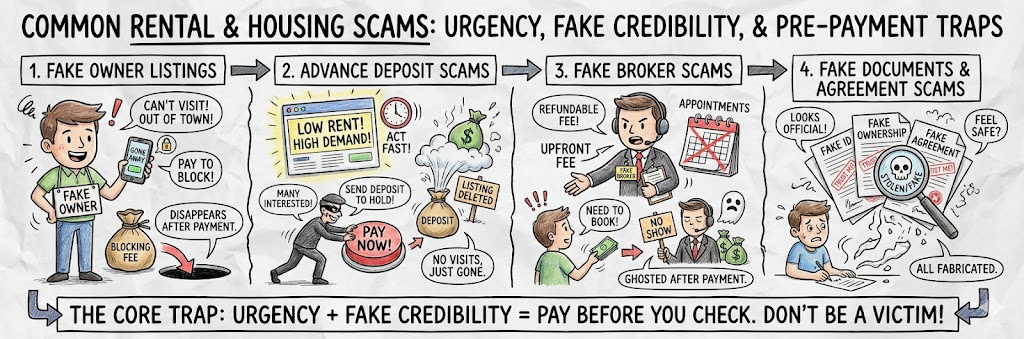
To seem more trustworthy, scammers in this scam say they own the property instead of being a broker. They often say they can’t come by or delay visits because they’re out of town or have tenants living there right now. They want a small amount of money to “block” the flat. Once the payment is made, the property is suddenly no longer available, or the person you were talking to disappears completely.
2) Advance Deposit Scams
These ads have low rent, nice pictures, and claims of high demand, which is unusual. The scammer tells the renter that many people are interested and pushes them to act quickly. The renter must send a security deposit to hold the property before any visits are set up. After you pay, the listing goes away and you can’t talk to anyone.
3) Fake Broker Scams
In this case, the scammer pretends to be a real estate agent who will help the client see the property. They charge brokerage fees up front, usually because they say they are refundable or because they need to make appointments.
The broker can’t respond after you pay this fee. There are never any visits because there is no real property.
4) Fake Documents and Rental Agreement Scams
Scammers may share fake documents like fake IDs, fake ownership papers, or fake rental agreements to make themselves look more trustworthy. These papers are meant to make you feel safe when you really aren’t. In reality, every piece of paper that is given is either stolen or made up.
The main thing that all of these scams have in common is that they use urgency and fake credibility to get renters to pay before they check.
Why Even Smart People Fall for Rental Scams
Scammers may share fake documents like fake IDs, fake ownership papers, or fake rental agreements to make themselves look more trustworthy. These papers are meant to make you feel safe when you really aren’t. In reality, every piece of paper that is given is either stolen or made up.
The main thing that all of these scams have in common is that they use urgency and fake credibility to get renters to pay before they check.
Red Flags You Should Never Ignore
- No physical visit allowed
- Asking for money before visit
- Rent too cheap for location
- Owner unavailable but “urgent”
- Only WhatsApp communication
- Pressure to pay immediately
If money is demanded early, it’s likely a scam.
How to Safely Search for a Rental Home
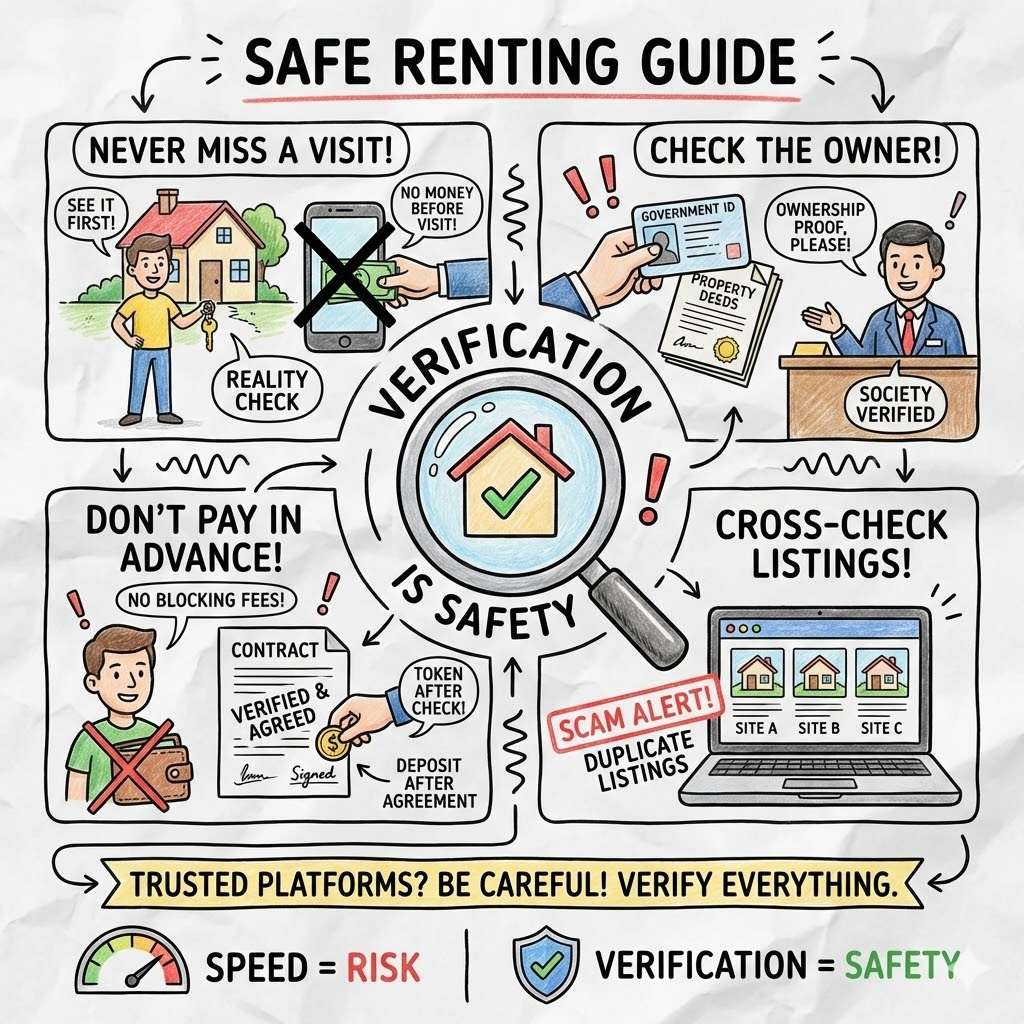
Never miss going to the property. Whatever the purpose or the urgency, never send money to buy a house you have not seen in actual sense. Check to see who the owner is. Request original government ID, ownership evidence, and verification by the management of the building or society.
Don’t pay in advance. You are only supposed to pay token amounts, deposits or blocking fee after they are checked and agreed upon. Check the listings again. When you can see the photos of the property in more than one listing or in websites which are not connected to the property this is a usual indicator of a fraud.
Do not be careless about trusted platforms. Much-used applications simplify the process, and they do not eliminate fraud. Until you can demonstrate otherwise consider all of the listings as unverified. Speed appears to be a priority when renting a place, but it is verification that will make you safe.
What to Do If You’ve Been Scammed
In the event that you think that you have become a victim of a rental scam or housing scam, take action. The recovery possibilities are minimized by delays. Cease all further payments immediately. Never send more money even when the scammer says that they need it to release or to refund the previous amount.
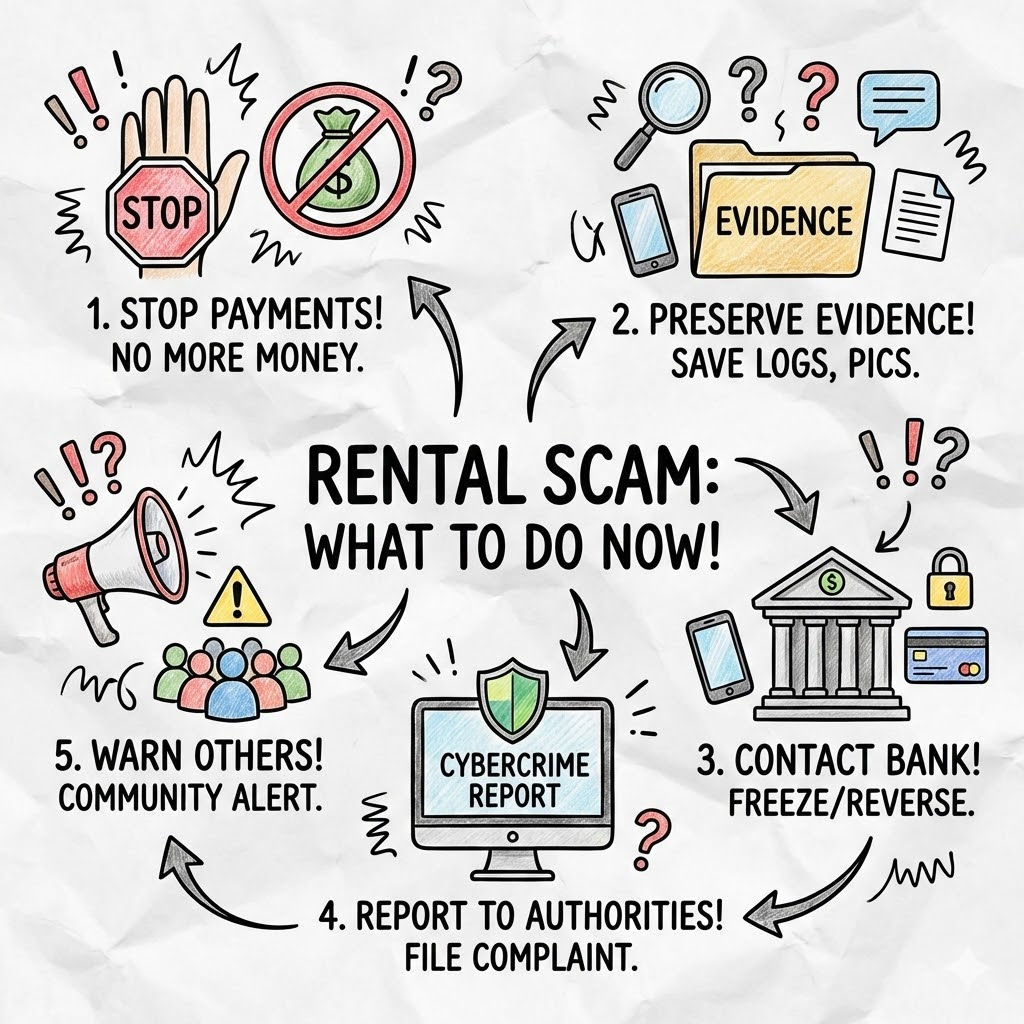
Preserve all evidence. Archive chat logs, phone contact details, screen shots of listings, payment receipt and documents sent. This data is of importance to be investigated. Contact your bank or payment provider. Freeze or reverse it where possible and label the transaction as fraudulent. Losses can be sometimes restricted by early notification.
Report the matter on the governmental cybercrime reporting site promptly. The reports received in time assist the authorities to detect patterns and trace of repeat offenders. Lastly, caution others in the local housing circles, society forums or rental communities. As citizens gain knowledge on how to tackle fraud, scammers are disrupted and they cannot use the same strategy.
The Bigger Problem
Rental scams are not important to everyone. They unfairly affect migrants to new cities, students, and families moving under time pressure, i.e., people who are already faced with new systems and have schedules to keep.
In addition to personal losses, these frauds continue to undermine the confidence in e-housing and online listing. Hesitation sets in when renters are no more able to differentiate between real opportunities and frauds. Genuine owners have a hard time reaching out to tenants, and even trustworthy sites are reputed to be damaged by malevolent users whom they did not invite to use the platform.
With the migration of the housing search procedure to the online platform, awareness is no longer a choice. The fact that it is the sole plausible weapon that renters possess against exploitation in an unregulated digital marketplace.
My Honest Opinion
There is no easy way to find a safe house. If someone tries to get you to pay before you trust them, that’s a warning sign, not a rare chance. A real rental can stand up to questions, delays, and scrutiny. As soon as verification starts, a scam falls apart.
It’s sad to lose a nice flat, but it’s only for a short time. Losing money to a scam is permanent, stressful, and often avoidable.
Final Thoughts
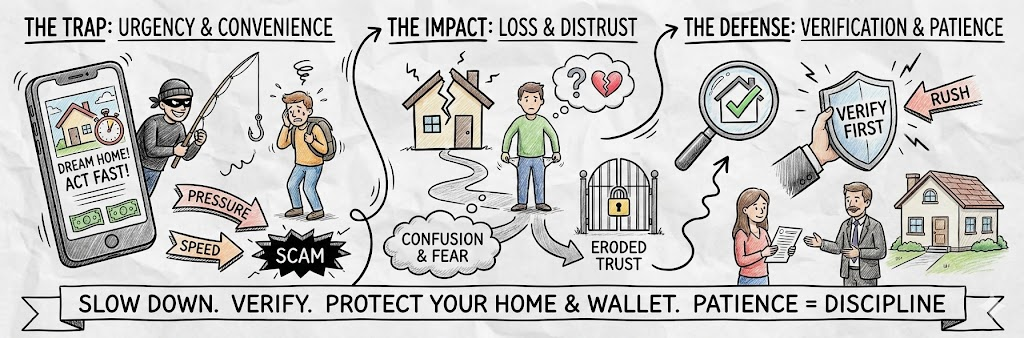
Fraudulent rental and housing schemes are on the rise due to the fact that urgency always overpowers common sense as the cities demand a lot and decent houses are bought within hours. Scammers know this stress and craft their tactics to capitalize on it which is with eye catching pricing, emotional appeals, and time sensitivity to get renters to make fast choices.
Speed is significant in real estate, but it is the verification which can save you. Going to the house, checking ownership, and spending time to make awkward inquiries might seem inconveniencing but these actions will mean the difference between a valid rental and an expensive mistake.
The Internet can simplify the process of house hunt, still, it is not able to substitute the personal judgment. There should not be any app, listing or message to be trusted without checking it independently. Patience is no hesitation when money is concerned–it is discipline. A house is also a symbol of stability, security and a new life. It must not be the cause of economic pressure or remorse. Few additional hours or days will cost you one opportunity, yet it can save you much more than a flat.
