
 TrendPedia
 How fast online learning has increased is difficult to believe. Online courses and certifications have become something that millions of people rely on in order to climb in their career, be it because they are mastering their job better or they are beginning as a freelance enterprise.
However, that rapid increase has also facilitated fraud to earn a lot of money.
Coexisting with legitimate platforms and trustful teachers, there has been an emergence of a shadow industry of fake online classes and certification scams that exploit individual motivation, the perceived need to get things done, and ignorance. Those that succumb to the tricks are usually assured jobs, good pay, or globally recognized certificates, but what they provide back as such are the useless PDFs, old content, or nothing at all after the money is paid.
It is not just money that is hurt. Learners who believe what they are offered are not right, will end up wasting time, losing confidence and even losing essential job momentum at times.
This article describes the mechanics of this group of scams, why they are so effective and why most individuals fail to notice these warning signs until it is too late. We shall consider more a little how these bogus classes operate, and how you may guard against falling into their traps.

What Are Scams for Fake Online Courses and Certifications?
Fake online course and certification scams are ways for people to make money by selling education that is not very useful in the real world. Usually, these businesses sell:
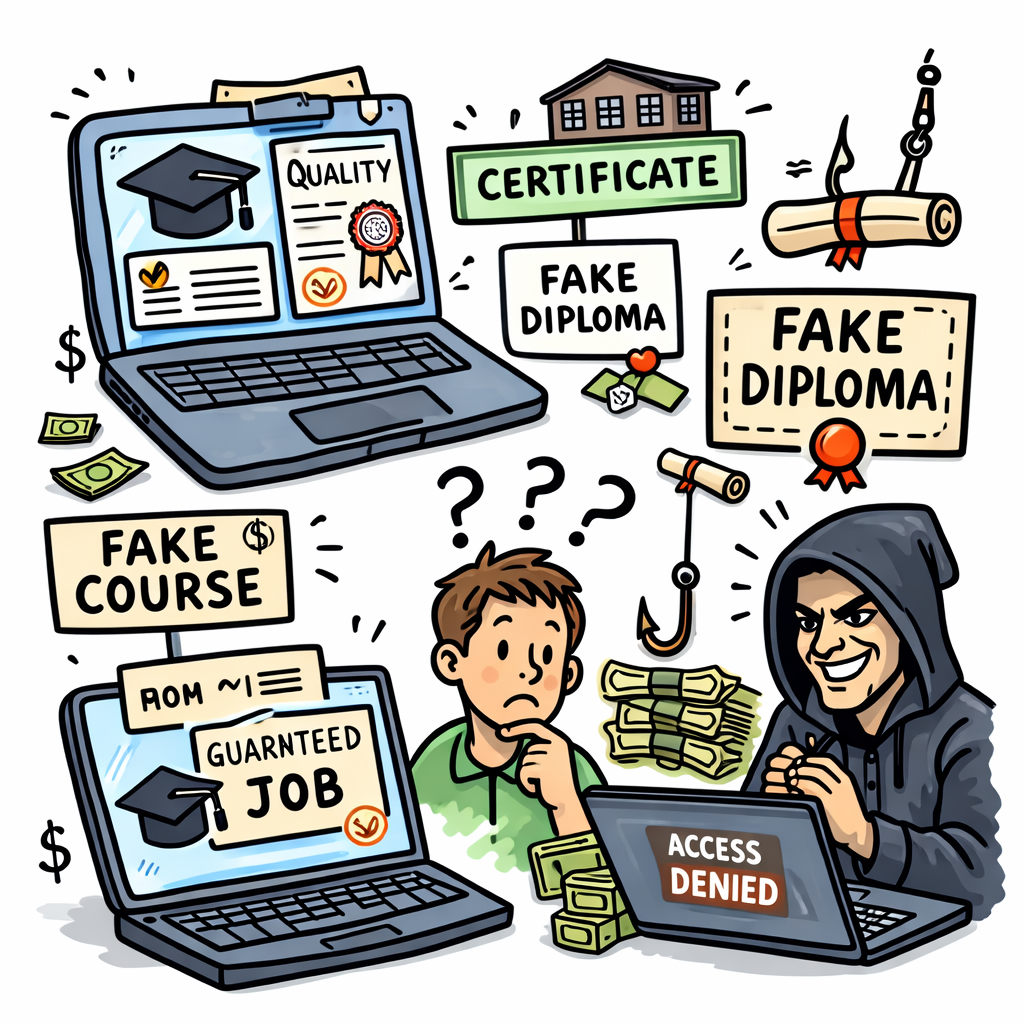
Fake courses or courses that are very low quality
Certificates that do not mean anything in the business world
Diplomas from schools that do not exist or are not accredited
“Guaranteed” job or placement programs
At first glance, everything seems fine. To make people trust them, they use professional-looking websites, polished ads, fake reviews, and language that sounds official. Some even pretend to be real organizations or use corporate logos in a way that makes them look trustworthy. But the goal is not to learn or get ahead in your career. It is exploitation through transactions.
After they pay, learners usually get recycled content, generic PDFs, certificates that do not mean anything, or nothing at all. Support stops, job offers disappear, and requests for refunds go unanswered. These scams are very dangerous for people who are new to learning or are switching careers because they look so much like real learning platforms.
Why These Scams Are Increasing Rapidly
It is not a coincidence that bogus online courses and certification schemes are on the rise. It is the expected outcome of a large number of people wanting something, technology, and poor oversight coming together.
1) A huge need for online learning
More people than ever are striving to make their financial situations better, and they are typically under a lot of stress. Learners want better jobs, the chance to work from home, speedier career changes, and quick skill upgrades that promise quick results. That sense of urgency is what scammers use to get in. People are more likely to put aside their doubts in favor of speed when they feel behind, underpaid, or stuck. Scammers make their proposals based on this way of thinking: quick results, little work, and big rewards.
2) Easy to make things look “legitimate”
Modern tools have made it easier for fraud to happen. These days, anyone can set up a professional-looking website, make fake reviews, create professional branding, and run paid ads in just a few hours. Before letting ads run, social media sites and ad networks do not often check to see if the schools are real. Because of this, scams often resemble like actual learning platforms, at least on the surface. Visual credibility is no longer a good way to tell if something is real.
3) Deception on a Large Scale by AI
The situation has gotten worse because of artificial intelligence. Scammers now utilize AI to write convincing course descriptions, make themselves sound like experts by using polished language, send personalized communications that sound like they are from real people, and fill comment sections with bogus evaluations and endorsements. People do not earn trust anymore; they make it.
These frauds are faster to set up, harder to spot, and more convincing than ever because they use a combination of urgency, professional presentation, and automated persuasion. It is important to understand these forces since the scams will not stop just because the tools get better.
Common Types of Course & Certification Scams
1) Courses that promise a job
These programs depend on claims like “job in 30 days” or “100% placement guarantee.” The wording is meant to be definitive so that doubt is not expressed. The simple truth is that no real training, school, or trainer can promise you a job. Hiring decisions are based on the job market, the candidate’s performance, the interviews, and the employer’s needs. A course provider has no power over any of these factors. If you see guarantees, they are just marketing nonsense and not a good way to build a business.
2) Fake certificates that say “International”
Scammers often say that their certificates are “accepted by top companies” or “recognized around the world.” Most of the time, the issuing group does not exist, is not accredited, or does not have anything to do with the industry it says it regulates. The value of a certificate comes from being recognized by companies and institutions, not from how nice it looks. If no one in the field knows who issued the license, it does not mean anything.
3) Course ads on WhatsApp and Telegram
Messages you did not ask for, big deals, and making things seem urgent are all common strategies here. Learners feel rushed by deals that are only good for a short time, countdowns, or claims that “only a few seats are left.” This sense of haste is on purpose. It stops doing your homework. Some people use high-pressure tactics to hide bad content, no help, or even fraud.
4) Free content that has been remixed and sold as “premium”
A lot of scams are just reselling simple recorded content, often the same as what is free on YouTube, but with better branding and higher prices. The person who wants to learn is not paying for depth, mentoring, or results; they are paying for presentation. Once entry is given, it is clear that there is not much there.
Why Smart Learners Still Fall for These Scams
The difficult truth is that these scams do not go after people who are stupid. Under pressure, they go after hope. They take advantage of people who are worried about their careers, afraid of losing out, compare themselves to peers who seem to be doing well, and want to save time in competitive job markets. People make decisions based on their emotions instead of their thoughts when they feel stuck or behind.
Intuition is clouded by emotion. Scammers know this and make sure that every message they send does the same thing. It is important to understand this process because “being smarter” is not the answer. It means slowing down, not believing what people say, and not letting pressure make choices for you.
Warning Signs You Should Never Ignore
In fake training and certification scams, there are some red flags that always show up. Patterns are important, even if one signal does not prove theft.
Watch out very carefully if you see:
Claims of jobs or placements that are sure
There is no information that can be checked about teachers or guides.
Not having a clear strategy for refunds or complaints
Only WhatsApp and Telegram can be used.
Pressure to pay quickly because of a “limited time”
Authentication information on certificates that is not clear or is missing
For schooling to be legal, there must be complete openness. When it is gone, value is almost always gone too.
How to Verify an Online Course Safely
It is less about gut feelings and more about following a plan to avoid scams. Choose a course like you would any other career choice, not like a hopeful gamble.
Find out about the teacher – Do not just look at names and pictures. Check the instructor’s past with outside sources. Check out their LinkedIn profiles, work history, past jobs, and knowledge in the subject they are teaching. If you cannot find any other proof of the instructor’s trustworthiness, you should leave.
Check to See If the Certificate Is Valid – Ask straight-forward things. Who gives out the certificate? Does it count with companies, schools, or professional groups? Then check the answers for yourself. Take screenshots and seller promises with a grain of salt.
Read reviews that are fair and unbiased – Online testimonials are used for business purposes only and are not proof. Find conversations about it on forums, Reddit posts, independent blogs, or review sites run by outside groups. Patterns are more important than single views.
Not Making Hasty Payments – Legitimate platforms do not force people to make choices quickly. They give students time to think about what they are learning, ask questions, and look at different options. There are ways to apply pressure to avoid being looked at.
What to Do If You’ve Been Scammed
If you think someone is after you, act quickly and carefully. Stop making any more payments right away. Keep all of your bills, records, emails, chat logs, and marketing materials. Tell your payment company or bank about the transaction and ask them to look into it. Report the crime to the organization in your country that handles hacking or protects consumers.
Finally, talk about your experience with other people when it is acceptable. Reporting these scams and making people aware of them help others avoid making the same mistake. Silence helps con artists. Taking action lessens their effect.
The Bigger Problem
Fake online courses do a lot more damage than just causing people to lose money. They make students less likely to believe online learning in general, even on legitimate sites. Since they have to fight with false advertising and empty promises, they hurt real teachers who put in real effort into their jobs. Over time, they also make students less sure of themselves, because being fooled once makes people doubt their own judgement. The credibility of digital learning is at danger if this trend is not stopped. Being aware is not a choice; it is necessary to protect the future of online learning.
My Honest Opinion
Investing in your education is a long-term process, not a quick way to get ahead or make money.
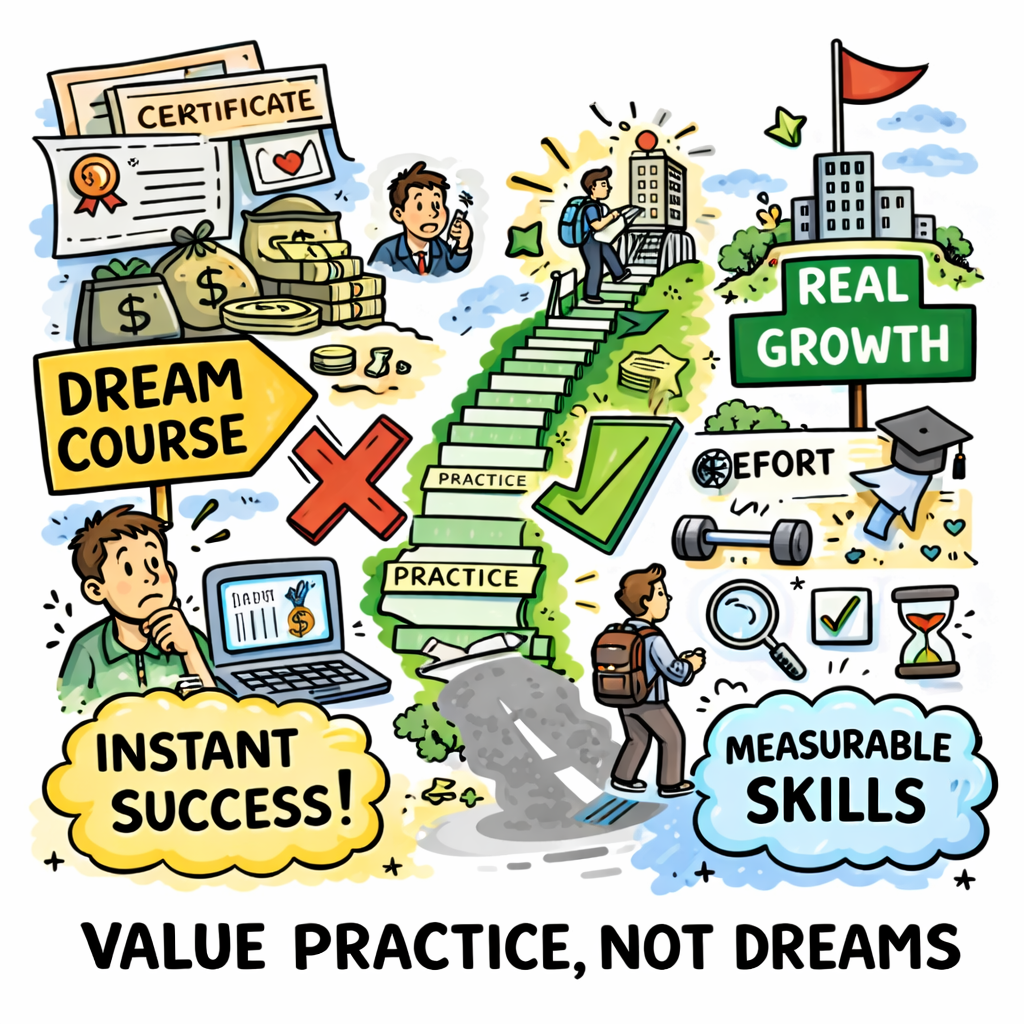
Any course that offers dreams instead of skills that can be measured should be looked at with suspicion right away. Certificates alone do not build careers, and no real education can turn hard work, practice, and experience into a sure thing. Real growth comes from practicing regularly, putting what you have learnt to use, and getting information from sources that you can check yourself. Anything that says otherwise is just selling hope, not skill.
Final Thoughts
People who fall for fake online courses and certificate scams are smart, so they do not last long. They stay alive because too many students make decisions quickly when they should take time to think about them. The fire is what we need. The box is a trick.
The student is now in charge when anyone can make a website that looks good, write convincing marketing copy, and sell “education” online. This does not mean you should blame the victims, but you should know that you need to be able to be sceptical. Think about what a class has to offer before you sign up for it. Ask about the specific skills you will learn and how they will help you in the real world. Also, find out if the teacher or school has a history that goes beyond what they say in their ads. If people answer in a way that is not clear, is emotional, or is defensive, you should leave.
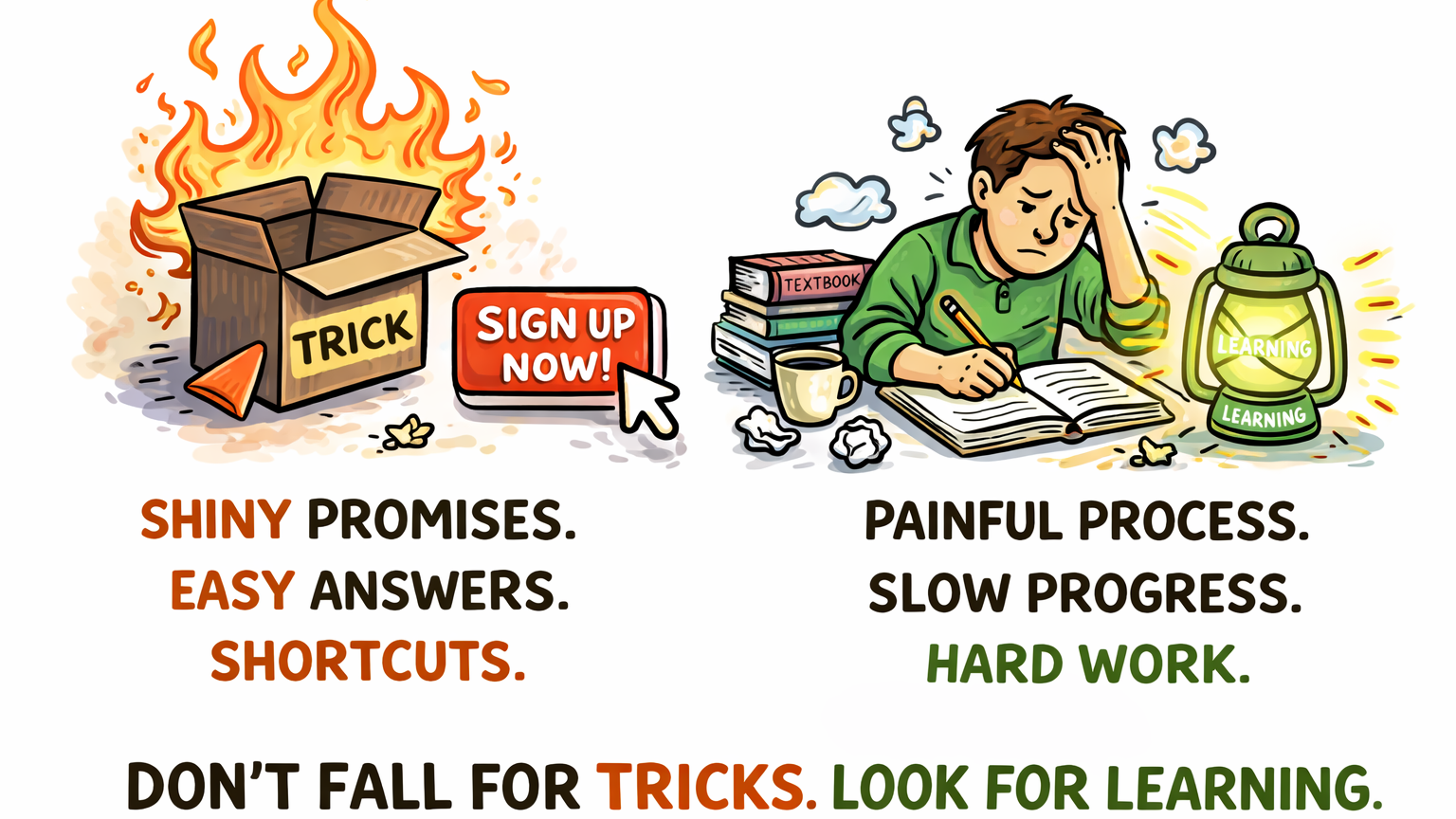
Keep this in mind: real education does not always feel important, flashy, or sure. Most of the time, it hurts, moves slowly, and is hard to deal with. You have to work on it before it works. That truth is the only thing that will help you grow. Anything else is just selling you a lie.
Going to school online is one of the best ways to get better at your job and yourself. But for students to use it well, they need to choose facts over promises, checks over thrills, and long-term value over short-term hope.
Tech has made it easy to learn things quickly these days. If you learn smart, you can protect your time, money, and future.
