
 TrendPedia
 I suggest to watch a video where a representative of the general population is making a statement so convincing that it seems that there is no need to question it. The movements of the face are in accord. The voice has some recognizable inflections. The performance is natural.
Yet the event never occurred.
This is not inability to see, it is the result of the fast development of artificial intelligence. Contemporary generative models have now acquired the ability to generate faces, voices and expressions with such realism that it is now challenging to human judgment and other conventional ways of verification.
By 2025, deepfakes will not be considered the experimental misuse of AI. They pose a structural threat to digital credibility, compelling societies, platforms, and institutions to reconsider the nature of the establishment of authenticity in an AI-first internet.
What Are Deepfake Videos?
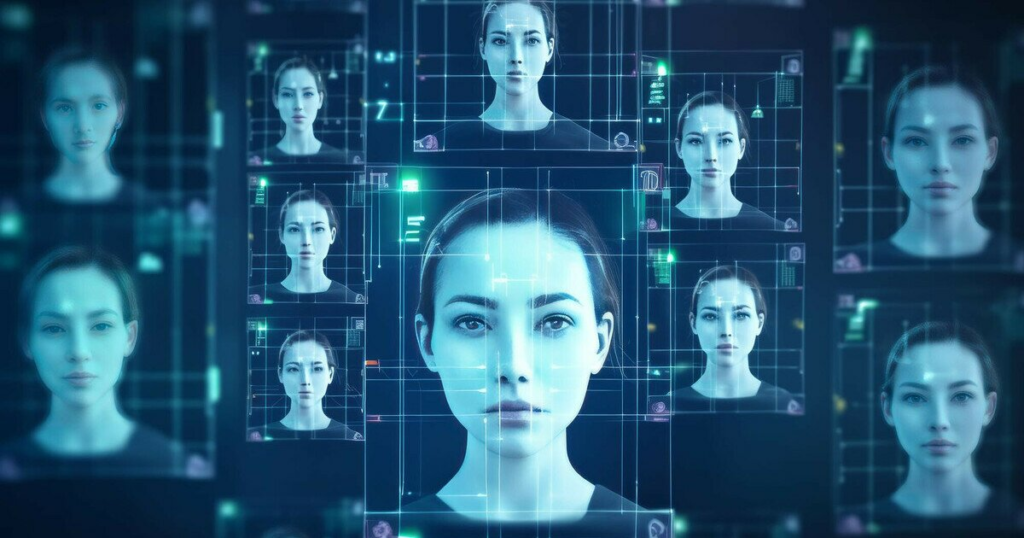
Deepfake videos are fake media that are generated or modified through artificial intelligence in order to make people look like they said or did things that were not real. These videos can accurately recreate the facial motions, voice patterns, and the expressions of a person with a blend of machine learning power and visual and audio synthesis methods.
The methods used in common behind deepfakes are facial mapping, voice cloning and large data-trained deep neural networks. When done properly, the consequence is content which is believably real – usually realistic enough to overcome human doubt.
Why Deepfakes Are Spreading So Fast
AI Tools Are Cheap, Powerful, and Widely Accessible
The aspects of developing a convincing deepfake were technical not long ago, and demanded a lot of computing resources. That barrier has been broken down to-day. Synthetic videos can be created by almost anyone with minimal effort and cost by using user-friendly apps and online tools to create a realistic one.
This availability has transformed deepfakes as an exclusive feature to mass-market mode.
Social Media Rewards Speed, Not Accuracy
Social platforms are not meant to be verified but reach and engagement. Once a deepfake is uploaded:
- Videos were popularized in feeds and messaging apps.
- Users post content and do not ask whether it is authentic or not.
- Emotional responses include shock, outrage, humor, and negate critical thinking.
Consequently, fake news tends to go viral more than the real news.
Attention Economics Favor Sensational Content
Deepfakes are provocative in nature. They use curiosity and controversy, which are algorithmically appealing. Social networks enhance what is popular and synthetic media is streamlined to do precisely that, whether it is accurate or harmful.
Detection Is Lagging Behind Generation
While AI systems for generating deepfakes improve rapidly, detection tools struggle to keep pace. This imbalance creates a widening gap where manipulated content circulates freely before being identified, flagged, or taken down.
Deepfake Scams Are Increasing
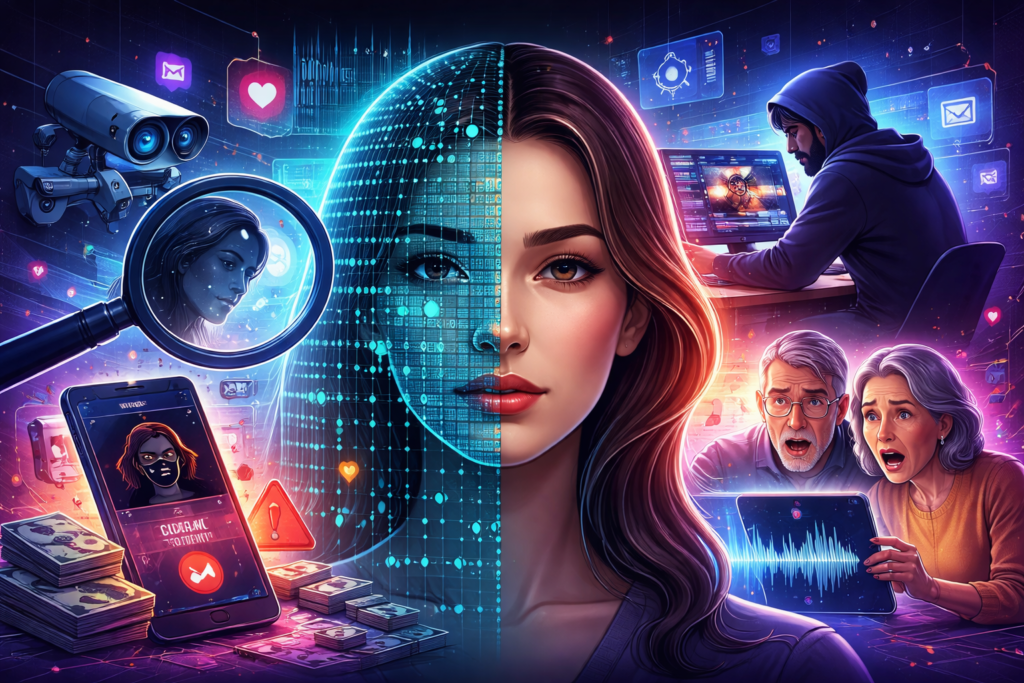
Deepfakes are no more associated with fake news or viral hoaxes. They are being used more and more to commit fraud and social engineering. Deepfake is used by scammers these days to:
- imitate relatives or close associates.
- Prepare counterfeit emergency calls so as to create panic.
- Pantomime authority figures e.g. police officers, executives or government officials.
Humans tend to believe those they hear and those that they see. Deepfakes use the fact that this is a psychological shortcut that makes trust vulnerable.
Why Indian Users Are Especially Vulnerable
Rapid Digital Adoption
The number of first-time internet users has increased significantly in India. Mostly video and audio information is used by millions, and they do not tend to verify the information whether it is true or not.
High-Trust Social Norms – Culture also matters. People tend to trust:
- Elders and family members
- People in charge
- Famous or renowned social personalities.
Deepfakes deceive such signals of trust, and scams are more believable and difficult to question.
Can You Spot a Deepfake?
Sometimes – but not always.
The early deepfakes were obviously flawed. Many of them now are so good that they can deceive even watchful eyes.
These are the typical warning signs:
- Abnormal or excessive eye movement.
- Blurry or shaky face edges
- Tongue and mouth otherwise than heard.
- Unfitting lights and shadows.
However, AI media are improving quickly. Visual and audio cues do not work well in detecting fake content as the tools improve.
How to Protect Yourself from Deepfakes
Don’t Trust Viral Content Instantly
Pause before reacting or sharing. Emotional urgency is often a red flag.
Verify Information from Multiple Sources
Cross-check claims with trusted news outlets or official channels.
Limit Sharing of Personal Media
Avoid oversharing videos or voice samples that could be misused for cloning.
Educate Family Members
Elders and children are often the most targeted. Awareness is a critical first line of defense.
What Platforms and Governments Are Doing
Efforts to address deepfakes are underway, including:
- AI-based detection and watermarking tools
- Content labeling and platform-level moderation
- Ongoing legal and policy discussions
However, regulation and enforcement are still struggling to keep pace with the speed of technological advancement.
The Bigger Question
We will no longer be believing what we see and the fundamental pillars of digital trust will be modified. Long time before, photos and videos were the evidence that something had occurred. Deepfakes dispel that concept and cause suspicion of the formats that we previously relied on.
It is not a technical issue but a social issue. Since the fake media bears the appearance of the actual objects, we cannot afford to trust our eyes and ears only. We should restore confidence through context, verification and credible sources.
Deepfakes leave us with a bitter pill to swallow: in the era of reliance on digital information, authenticity is no longer a given, but it has to be demonstrated. Whether we will live in a world of manipulated media is not actually the question, but can our systems, platforms, and habits adapt quickly enough in order to retain faith in an AI-driven internet?
My Honest Opinion
Deepfake technology is not a bad thing per se. The use of artificial intelligence is like the majority of new ideas, depending on the use. The threat is not the technology, but rather a vulnerability to the absence of protection, responsibility and the ignorance of the masses. The future of digital trust will be based on three significant factors:
Knowledge – being aware that fake media is a reality and doubting everything that elicits such a strong emotional response.
Media literacy – knowing how to question sources, situation and reliability rather than simple appearance at the images.
Accountable AI creation the design of systems that are transparent, capable of identifying fraud, and adhering to ethics throughout the design. Deepfakes teach us that advancement in the use of technologies without corresponding responsibility is perilous. This is not aimed at preventing new ideas but is meant to guide them in such a way that they safeguard the truth, trust, and people.
Final Thoughts
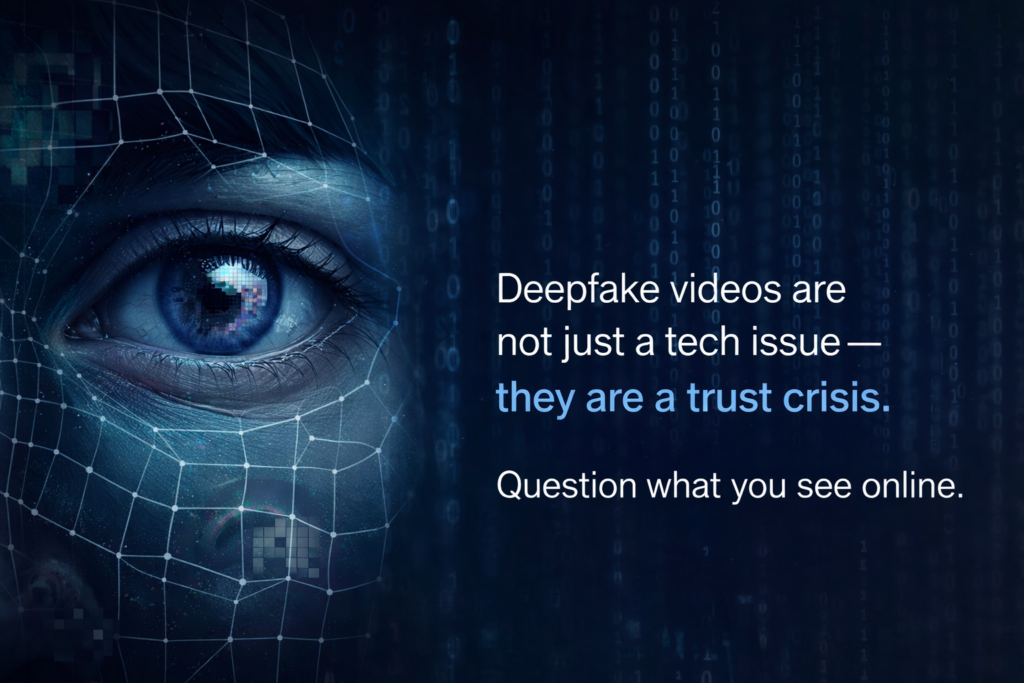
Deepfakes do not only represent a technology issue. They demonstrate that trust is becoming weaker. With the evolution of AI in the composition of content, we should not say any more that we take the things we see and hear as true. Anyone who is also skeptical is not cynical in the digital world. It is one of the means to defend ourselves. It is becoming important to stop, ask questions and scrutinize what we see on the internet.
Critical thinking of digital content is not a choice. It is an ability that we must have to dodge an AI world.
